
What Every Dentist Should Know About Tongue-Ties and Airway Health
(and How SLP Collaboration Improves Outcomes)
SLPs are often the ones seeing how those restrictions show up functionally in feeding, speech, and oral coordination.
When those two perspectives come together, outcomes change.
Tongue-ties (ankyloglossia) are no longer viewed as isolated oral findings. Today, they are increasingly understood as part of a larger functional picture that includes airway stability, oral posture, and craniofacial development.
At Chrysalis Orofacial, we support dentists and therapy professionals in building collaborative care pathways that connect structure with function, especially in complex pediatric and adult cases.
What Is a Tongue-Tie? (Short Definition)
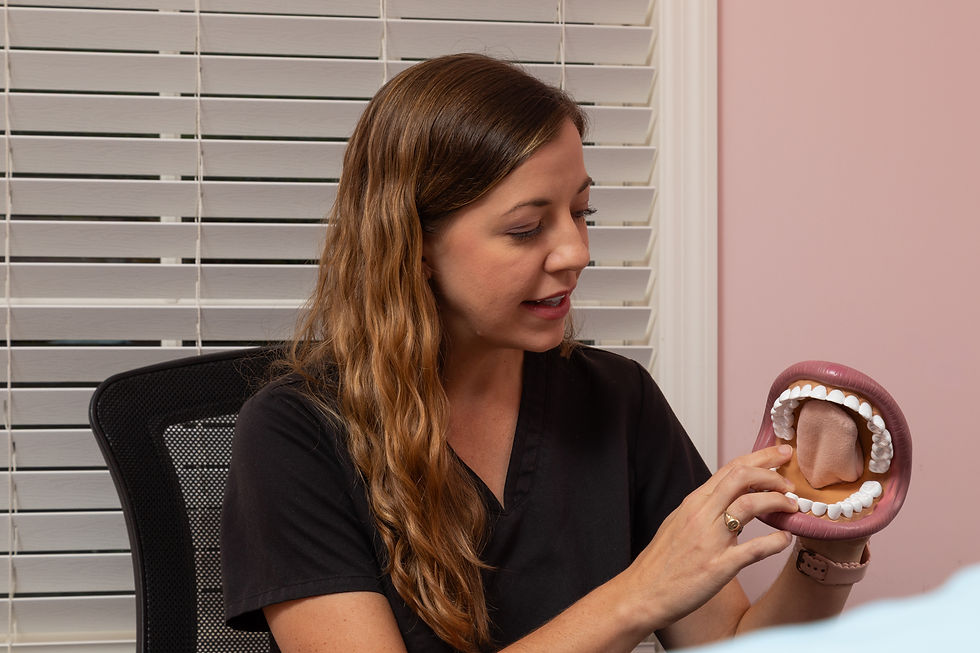
A tongue-tie, clinically known as ankyloglossia, is a restriction of the lingual frenulum that limits tongue mobility and can influence feeding, speech, oral posture, and airway function.
Some restrictions are obvious. Many are posterior or submucosal and require functional assessment to fully understand their impact.
Why Tongue-Ties Require a Team-Based Lens
Tongue mobility plays a central role in:
Oral rest posture
Nasal breathing
Palatal development
Feeding coordination
Airway stability during sleep
Dentists often identify the structural signs:
Narrow or high palates
Crowding
Bruxism
Mouth breathing
Forward head posture
SLPs frequently observe the functional consequences:
Inefficient feeding
Poor oral coordination
Compensatory swallowing patterns
Speech challenges
Fatigue or instability during meals
Individually, each discipline sees part of the picture.
Together, they see the whole patient.
In Simple Terms
If the tongue cannot move the way it is designed to, the body adapts.
Dentists may notice changes in growth and structure.SLPs may see challenges in feeding and speech.Families may notice poor sleep or chronic mouth breathing.
Tongue-ties do not just affect oral anatomy. They influence breathing, development, and function across systems.
That is why collaborative care matters.
The Airway Connection: Where Dentistry and SLPs Meet
The tongue is a primary airway stabilizer.
When tethered oral tissues restrict movement, patients may develop:
Low tongue resting posture
Reduced nasal breathing
Altered swallowing patterns
Increased risk for sleep-disordered breathing
Dentists are uniquely positioned to identify early structural indicators.
SLPs help assess how those restrictions impact function, coordination, and carryover into daily activities.
This partnership allows for more informed decisions and more complete treatment planning.
For broader clinical guidance on feeding and oral development, providers may reference evidence-based resources from the American Speech-Language-Hearing Association.
Why Release Works Best With Functional Support
Frenectomy can be an important part of care.
But structural change alone does not automatically create functional change.
SLPs help support:
Pre-release oral motor preparation
Post-release coordination and strength
Resting posture retraining
Feeding mechanics
Airway-supportive habits
When dental providers and SLPs collaborate before and after release, patients are better supported in integrating new movement patterns.
This reduces compensations and improves long-term outcomes.
How SLP Collaboration Supports Dental Care
From a collaborative standpoint, SLPs can assist dentists by:
Providing functional assessments alongside structural findings
Supporting muscle retraining after release
Helping families understand home carryover
Monitoring feeding and speech progress
Identifying when additional referrals may be helpful
Rather than replacing dental expertise, therapy providers extend it into daily function.
That is where interdisciplinary care becomes powerful.
Practical Collaboration Tips
Here are simple ways dentists and SLPs can strengthen outcomes together:
Share evaluation findings.Structural and functional insights together create clearer treatment plans.
Refer intentionally.Build relationships with therapists trained in airway-centered care.
Coordinate timing.Pre- and post-release therapy improves integration.
Educate families jointly.Unified messaging builds trust and compliance.
Follow progress collaboratively.Ongoing communication supports sustainable change.
Frequently Asked Questions
Are all tongue-ties visible?
No. Many restrictions are posterior or submucosal and require functional evaluation.
Can tongue-ties affect airway health?
Yes. Restricted tongue mobility can alter oral posture and breathing patterns over time.
Should every tongue-tie be released?
Not necessarily. Decisions are best made through interdisciplinary assessment.
What role do SLPs play in tongue-tie care?
SLPs support feeding, speech, oral coordination, and functional integration before and after release.
Why is collaboration so important?
Because structure and function are inseparable. Patients benefit when both are addressed together.
Ready to Strengthen Your Interdisciplinary Approach?
If you want to confidently connect tongue-ties, airway health, and orofacial function within a collaborative care model, Plot The TOT offers advanced training designed for dentists, SLPs, OTs, and healthcare professionals.
You will gain:
Structured airway-centered assessment strategies
Real interdisciplinary case walkthroughs
Treatment planning frameworks
Downloadable tools and resources
Live expert Q&A
Built to support providers managing complex orofacial and airway presentations as a team.
👉 Explore Plot The TOT and strengthen your collaborative clinical impact.
You can also join our newsletter or follow Chrysalis Orofacial on social media for ongoing case studies, interdisciplinary insights, and upcoming trainings.


Comments